

Your first pour-over tastes bright and balanced. The next tastes thin, even though you used the same coffee and dripper. The missing detail is often not a new grinder setting or a different filter. It is the amount of coffee and water that actually went into the brew—and how quickly the water was added.
A coffee scale with timer puts those two variables in one place. Weight keeps the recipe measurable; time shows whether the pour or espresso shot is moving faster or slower than intended. The Yozcoffee Coffee Scale with Timer combines a 2 kg capacity, 0.1 g display increments, simultaneous weight-and-time readouts, USB-C charging, and a removable silicone pad in a compact aluminum-alloy body.
The scale does not make decisions for you. What it does is replace vague instructions such as “add a little more water” with numbers you can repeat, compare, and adjust.
Why weight and time belong together
A useful coffee recipe answers at least three questions: how much dry coffee was used, how much water or espresso reached the cup, and how long the process took. Measuring only one of them leaves a blind spot.
For pour-over, the ratio controls the overall concentration while the pouring schedule affects how the coffee bed is saturated. You might finish two brews at exactly 300 g, but one reaches that weight in two minutes and the other in four. They are unlikely to taste identical.
For espresso, the same principle becomes dose, beverage yield, and shot time. A grinder change can make the same target yield arrive much earlier or later. Watching weight and time together makes that change obvious before you taste the cup.
This is why a dual-zone display is more practical than switching back and forth between a separate timer and a weight screen. It keeps the relevant numbers visible while your other hand is holding a kettle or reaching for the machine control.
What the numbers on this scale mean
The Yozcoffee model is listed with the following specifications:
| Feature | Listed specification | What it changes in daily use |
|---|---|---|
| Maximum capacity | 2 kg | Supports coffee, water, a brewer, and a server within the total load limit |
| Display increment | 0.1 g | Shows small dose and yield changes that whole-gram kitchen scales may hide |
| Display | Weight and timer shown together | Lets you monitor the recipe without a separate stopwatch |
| Body and top | Aluminum-alloy body with tempered-glass top | Creates a rigid platform with a wipe-clean surface |
| Pad | Removable, heat-resistant silicone | Adds grip and separates the vessel from the glass surface |
| Charging | USB Type-C rechargeable | Avoids disposable batteries; a charging cable is included |
| Finish | Black | Matches the single finish currently listed for this model |
One wording detail matters: 0.1 g describes the scale's displayed increment. It should not be treated as a laboratory accuracy guarantee. Use it to make small, repeatable brewing adjustments, and avoid leaning on the platform or placing an item so that it touches the counter.
The product page does not list external dimensions. If the scale is intended for an espresso machine, measure the drip tray and the clearance below the portafilter before ordering. A compact-looking scale can still be too wide or too tall for a particular machine-and-cup combination.
A repeatable pour-over method
Start with a simple recipe, then let taste decide the next adjustment. The example below uses 20 g of coffee and 300 g of water, a 1:15 ratio. It is a baseline rather than a rule for every bean or dripper.
- Place the server and dripper on the scale. Make sure the setup sits flat, stays within the 2 kg total capacity, and does not press against another object.
- Tare the display. Add 20 g of ground coffee. If you overshoot, remove a small amount rather than accepting a different dose without noting it.
- Tare again and start the timer with the first pour. Add about 40 g of water for the bloom, wetting the coffee bed evenly.
- Pause briefly, then continue in controlled pours. A 30–45 second bloom is a practical starting range, but coffee freshness and roast level can change how the bed behaves.
- Stop at 300 g. Record the total brew time and taste the cup after it cools slightly.
If the brew tastes weak and drains unusually fast, grind size may be one useful variable to test. If it tastes harsh and the drawdown runs long, a slightly coarser grind may help. Keep the 20 g dose and 300 g water target steady while testing so the comparison means something.
The timer also helps reveal inconsistent pouring. If one brew reaches 200 g much earlier than the last one, you changed the water delivery even if the final ratio is identical. That is useful information, not a failure.
Using the scale for espresso yield
Espresso machines create a tighter fit problem. Before brewing, place the scale on the drip tray and check that it is fully supported. Then set the cup on top and confirm there is enough clearance below the portafilter. Do this while the machine is idle; forcing an oversized setup into place is not worth a spilled shot.
Once the fit is confirmed, tare the cup and start the timer as the pump starts. Suppose you begin with an 18 g coffee dose and choose 36 g in the cup as an initial 1:2 yield. Stop the shot at the target weight, note the elapsed time, and taste. The ratio is a controlled starting point, not a promise that every coffee should run to the same number.
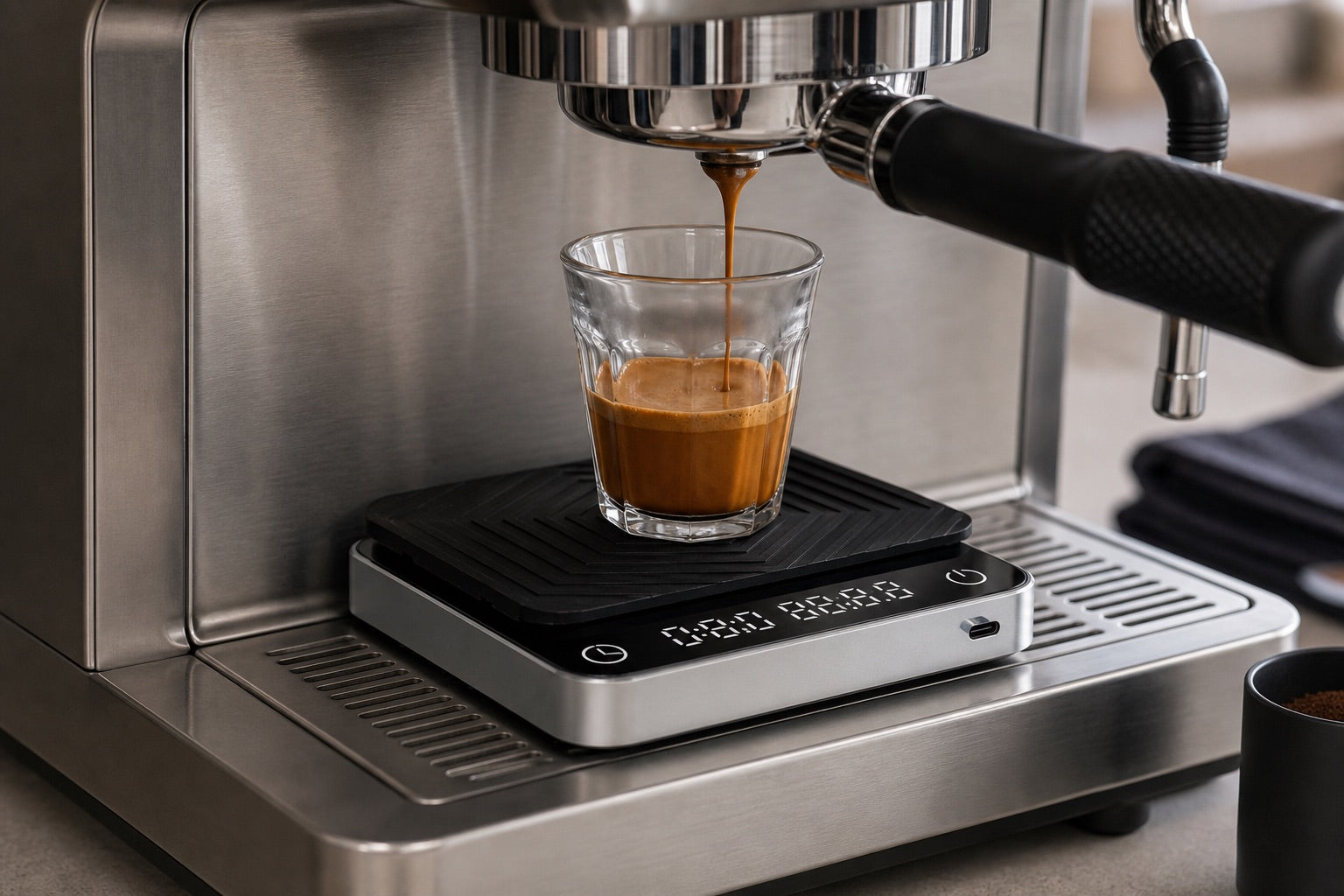
If 36 g arrives much faster than the previous shot and tastes thin, keep the dose and yield fixed while trying a finer grind. If it arrives very slowly and tastes dry or bitter, test a small coarser adjustment. Change one variable at a time. Otherwise, the scale will give you precise-looking data from an experiment you cannot interpret.
The scale is also useful for weighing the dry espresso dose before brewing. Just remember that the combined brewer, vessel, water, and coffee load must stay within the listed 2 kg capacity.
Where else a digital coffee scale helps
The product page lists AeroPress, Chemex, Moka pot, V60, standard pour-over, espresso dosing, and light kitchen preparation as suitable uses. The method changes by brewer, but the core habit stays the same: tare the vessel, add a known amount, and write down enough information to repeat the result.
For AeroPress, a scale helps hold the coffee-to-water ratio steady while you test steep time. For a Chemex or larger pour-over server, check the complete setup's total weight before brewing because the glassware and water both count toward the 2 kg limit. With a Moka pot, weigh coffee and water during preparation rather than placing a hot brewer straight from the stove on the scale.
The 0.1 g display is also convenient for beans or other small ingredients. It is less suitable for jobs above 2 kg, and the product does not advertise app connectivity. If automatic logging or Bluetooth recipes are essential, compare the workflow in our smart Bluetooth coffee scale guide. For a larger kitchen capacity, compare a different category of scale.
Care, charging, and spill habits
Remove loose grounds after each session. Wipe the tempered-glass surface and silicone pad with a soft damp cloth, then dry both fully before storage. The listed care guidance says to avoid abrasive cleaners, which can scratch or dull the surfaces.
The silicone pad is removable and described as heat-resistant, but it should not be treated as permission to place cookware directly from a burner on the scale. The pad is useful for grip and everyday brewing heat; extreme heat can affect the pad, glass, electronics, or load sensor.
The product page does not claim waterproofing. Wipe spills promptly rather than rinsing or immersing the scale, and keep the USB-C port dry. Charge it with the included cable when needed, but do not assume a specific charging speed or battery runtime because those figures are not listed.
Store the scale on a stable surface without a permanent load on the platform. Before the next brew, check that no coffee bean or trapped ground is lifting one corner or touching the weighing platform.
Is this coffee scale with timer the right fit?
This model makes sense for someone who wants one tool for manual brewing and espresso: a readable 0.1 g increment, a 2 kg ceiling, a simultaneous timer, a protective silicone pad, and USB-C recharging. It is particularly useful if your recipes are still described in scoops, kettle marks, or guesses about shot volume.
It may not fit a very small espresso drip tray, and its capacity is not intended for heavy kitchen work. It also does not promise connected-app features or waterproof construction. Those are not small details if they are central to your routine.
The practical buying test is simple: confirm the load capacity for your largest brewing setup, measure the available espresso-machine space if relevant, and decide whether manual weight-and-time tracking is enough. If it is, review the full specifications and included items for the Yozcoffee Coffee Scale with Timer.
Related coffee guides
- Pour-Over Coffee Ratio Guide for Better Coffee at Home
- Smart Bluetooth Coffee Scale: A Better Way to Brew
- Espresso Channeling: How to Fix Uneven Extraction
Frequently asked questions
Is 0.1 g the same as accuracy?
Not necessarily. The product lists 0.1 g precision, and the display shows changes in tenths of a gram. Without a separate tolerance specification, it is safer to describe 0.1 g as the display increment rather than a guaranteed ±0.1 g accuracy.
Can I use this scale for both pour-over and espresso?
Yes, the product page lists both uses. For espresso, measure the drip tray and cup clearance first because the scale's external dimensions are not listed on the public page.
Does the timer run while the scale shows weight?
Yes. The scale is described as having a dual-zone display that shows weight and timer simultaneously.
Is the coffee scale waterproof?
The product page does not make a waterproof claim. Clean it with a damp cloth, dry it fully, keep the charging port dry, and do not immerse it.
What comes in the box?
The listing includes one coffee scale and one USB charging cable. The scale is currently listed in Black with a removable silicone pad.